








AI Reshapes the Storage Experience: QNAP Qu405 NAS Released, a Flagship Four-Bay NAS for Under 3200 Yuan
Amidst fierce competition in the home and small-to-medium-sized enterprise (SMB) storage market, QNAP recently launched its flagship Qu405 four-bay NAS. Positioned as a "high-performance + intelligent" storage device, it features an Intel Core N355 processor and 16GB of DDR5 memory. It's the first mid-range NAS to introduce the MCP AI interaction protocol, coupled with dual-system support and a full range of interface options. Priced around 3200 RMB during the Double 11 shopping festival, it redefines the mid-range NAS market benchmark.
Comprehensive Hardware Evolution: The Art of Balancing Performance and Portability
The Qu405 boasts a comprehensive hardware upgrade, featuring the latest generation Intel Core N355 processor with an 8-core, 8-thread design, a maximum turbo frequency of 3.9GHz, and 6MB of high-speed cache. Real-world testing data shows that its overall performance is 100% higher than the previous generation N6005 processor, and it also boasts a 19% performance advantage over the Pentium Gold 8505 processor used in mainstream high-end NAS devices, providing ample computing power for multitasking, Docker container operation, and lightweight video processing.
The leap in graphics processing capabilities is a highlight. This processor features a built-in 32 EU integrated graphics, supports 4K@60Hz video hardware decoding, and, with its HDMI 2.1 interface, can directly output high-definition audio and video signals, ensuring a smooth playback experience whether setting up a home theater or previewing video footage in a small studio. The enhanced hardware decoding capabilities also allow the Qu405 to process multiple video streams simultaneously, meeting the needs of multiple users sharing viewing.
In terms of storage expandability, the Qu405 adopts a "4+2" hybrid storage architecture: the front provides four SATA interfaces, supporting 3.5-inch or 2.5-inch hard drives to build large-capacity storage pools; internally, it reserves two M.2 PCIe Gen3 slots, which can be used to install SSDs as high-speed caches or independent storage pools. Through Qtier automatic tiered storage technology, frequently used files can be migrated to SSDs for faster access. The memory configuration is even more impressive, featuring 16GB of Kingston DDR5 high-speed memory as standard. Although the official maximum support is 16GB, actual testing shows it can be expanded to 24GB, further enhancing multi-tasking concurrency capabilities.

The network and interface configuration balances speed and convenience. The rear of the chassis is equipped with dual 2.5GbE network ports, supporting link aggregation technology, with a theoretical transmission rate of up to 5Gbps, four times faster than traditional gigabit ports, reducing the time for transferring large video files by 80%. The interface layout has been comprehensively optimized: a front-mounted Type-C USB 3.2 Gen2 port (10Gbps) with a one-button backup function allows for near-instantaneous data backup when an external hard drive is connected; the rear-mounted dual USB 3.2 Gen2 ports, HDMI 2.1 port, and password reset button meet diverse needs for external devices and display output.
Cooling and design have been upgraded simultaneously. The Qu405 uses a large 14cm rear fan, combined with a dedicated processor cooling module, to quickly dissipate heat and ensure stability under prolonged high loads. The chassis design has been redesigned with sharp, beveled edges, and the side features an subtly engraved "QNAP" logo, all in a business-like all-black color scheme. The dimensions are controlled at 165×168×217mm, and the weight is roughly the same as its predecessor, balancing aesthetics on a desktop with portability. The packaging also features a new black design, with further reinforced internal shockproof structure for enhanced transport safety.
AI Interaction Revolution: Natural Language Reconstructs NAS Management Logic
The core breakthrough of the Qu405 lies in the introduction of QNAP's new MCP Assistant AI service, which drastically lowers the barrier to entry for NAS use through natural language interaction. MCP (Model Context Protocol), as an open AI operating protocol, builds a communication bridge between applications and NAS functions, allowing users to manage devices using only everyday language without needing to learn complex backend operation logic.
In compatible applications such as Cherry Studio, users only need to enter "Create a new user TEST with read-only access to the Media folder, password xxx," and the MCP system will automatically call the NAS API, completing a series of operations such as user creation and permission configuration within seconds. This function saves more than 80% of the time compared to traditional operation processes, especially solving the pain point of non-technical users having to "find menus and change parameters."
File management and troubleshooting efficiency achieve a qualitative leap. Combined with QNAP's Qsirch search engine, users can directly initiate queries using natural language, such as "Find all family gathering photos taken in September 2025," and the system will quickly match file attributes and content characteristics, accurately returning results. For professional needs such as log analysis, MCP can automatically parse SSH login records, port scan traces, and other data to generate analysis reports that include risk assessments and solutions, making it easy for even non-professional users to handle network security issues.
For needs beyond the direct scope of API operations, the AI assistant provides visual operation guides. When a user requests commands such as "disable SSH access on the web," the system will generate a step-by-step tutorial with screenshots based on the actual device configuration, providing a "teaching a man to fish" effect. Currently, this feature supports four core categories of functions: user management, group configuration, shared permission settings, and file operations, with strictly controlled permission scope to avoid security risks from accidental operations.
Activating this feature requires three conditions: the device is running QTS 5.2 or QuTS hero h5.2 or later, the MCP service plugin is installed, and compatible applications such as Cherry Studio are deployed on the PC. QNAP stated that the Beta testing phase has covered mainstream models, and more functional modules will be gradually released through updates, with plans to add advanced capabilities such as image generation and audio/video recognition.
Dual-System Support: Covering All Needs from Home to Enterprise
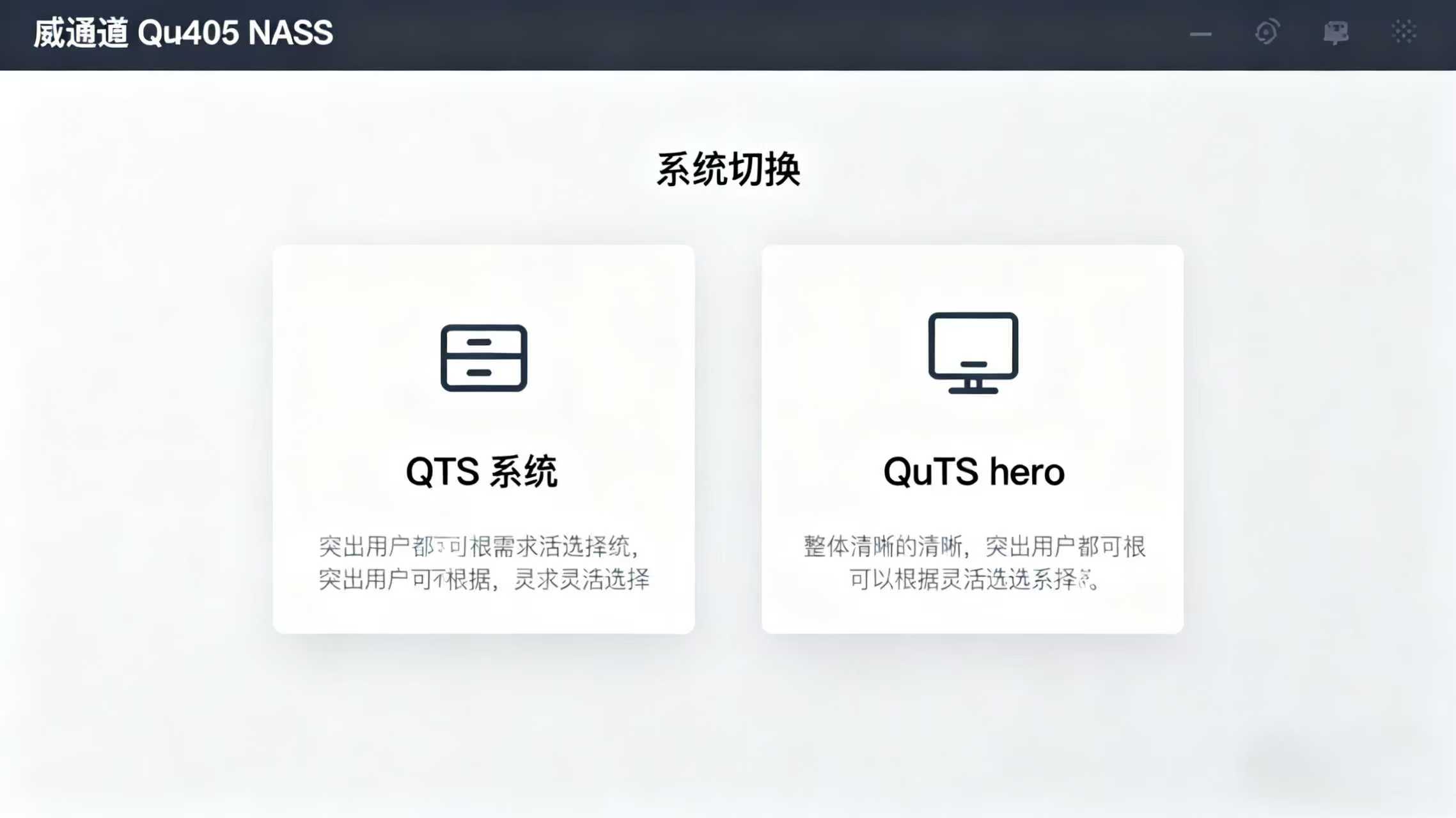
The Qu405 continues QNAP's "system choice" product strategy, supporting switching between QTS and QuTS hero systems, making it one of the few four-bay devices compatible with both EXT4 and ZFS file systems. This configuration meets the ease-of-use needs of home users while also adapting to the professional storage scenarios of small and medium-sized enterprises.
The QTS system emphasizes versatility and ease of use, featuring built-in HBS3 multi-device backup tools, HDP Windows full-system backup, and other practical functions. It supports a 3-2-1 backup strategy, allowing data to be synchronized to the cloud, external hard drives, and other terminals. Combined with AI hard drive lifespan prediction technology, it maximizes data security. For home users, applications such as Photo Station for photo management and Plex media server can be installed directly, quickly building a personal digital center.
The QuTS hero system caters to professional needs, offering enterprise-level features such as block-level snapshots, data deduplication, and compression based on the ZFS file system. A single file system supports up to 2 million snapshots, allowing for instant recovery of any historical version of data. This feature is particularly important for small studios, allowing designers to easily revisit project file modification records and avoid creative loss due to accidental operations. Switching between the two systems requires no device reinstallation, allowing users to flexibly choose according to their needs.
The openness of the software ecosystem further expands the product's boundaries. The Qu405 supports Docker containers and virtual machine deployment, allowing users to install thousands of third-party applications through the application center to build personalized scenarios such as personal cloud notes, smart home hubs, and lightweight servers. QNAP has also opened up new features such as File Station 6 in its Beta program, creating synergy with MCP AI services.
Market Breakthrough: 3200 Yuan Pricing Disrupts the Industry Landscape
The Qu405's pricing strategy demonstrates a strong market aggressiveness. According to QNAP's official information, this flagship four-bay NAS is priced at approximately 3200 yuan during the Double 11 shopping festival. The 8-bay model in the same series, the Qu805, is only around 3700 yuan, making it 15%-20% cheaper than competing models with similar configurations, continuing the brand's tradition of offering exceptional value for money.
This pricing strategy precisely targets the core competitive segment of the current NAS market. According to GrandView Research data, the global consumer NAS market reached $6.1 billion in 2024 and is projected to grow at an average annual rate of 12.1% from 2025 to 2030. Competition in the domestic market is particularly fierce. Synology's market share declined from 67% in 2019 to 24% in the first half of 2025, while UGREEN jumped to first place with a 42% share, making cost-effectiveness a key competitive factor.
QNAP's launch of the Qu405, Qu605, and Qu805 models forms a complete mid-range product matrix, targeting the market opportunities presented by the rise of domestic manufacturers. Compared to competitors like the UGREEN DXP4800Plus, the Qu405 boasts advantages in processor performance and AI capabilities; and compared to Synology's similarly priced models, its hardware configuration and system openness are more attractive, potentially leading to a breakthrough in market share for home and small-to-medium-sized enterprises.
Channel information shows that the Qu405 is currently available for pre-order on platforms such as JD.com, with the first batch of goods officially shipping in early November. QNAP is also launching a "trade-in" subsidy program, offering up to 500 RMB off old NAS devices, further lowering the barrier to upgrades for users.
Industry Implications: AI Becomes a Core Competitive Advantage for Storage Devices
The release of the Qu405 marks the NAS industry's entry into a new phase of "AI empowerment." For a long time, the contradiction between professional storage functions and ease of use has constrained the widespread adoption of NAS devices, but the implementation of natural language interaction technology is expected to break this deadlock. A QNAP product manager stated in an interview, "The launch of the MCP protocol is not simply a matter of adding features, but rather a restructuring of the interaction logic of storage devices, making AI a 'personal IT assistant' for users."
This trend has become a consensus within the industry. Recently released new products such as the Z425 from Extreme Space have also strengthened AI file management functions, while UGREEN has improved the intelligent experience by optimizing the Docker ecosystem. Analysis indicates that with the maturity of large language model technology and the reduction in local deployment costs, AI interaction will become a standard feature of mid-to-high-end NAS devices, and the focus of industry competition will shift from hardware parameter comparisons to a comprehensive contest of "computing power + algorithm + ecosystem."
For users, the launch of the Qu405 provides a new option that combines performance, intelligence, and cost-effectiveness. Home users can easily build AI-assisted digital warehouses, and small and medium-sized enterprises can obtain enterprise-level storage capabilities at a lower cost. As veteran user Wang Chaoyang stated in his hands-on testing, "The Qu405 truly transforms NAS from 'geek exclusive' to 'mass-market practicality,' especially its AI management features, which may completely change people's perception of storage devices." With the launch of the Double 11 promotion, the NAS market is poised for a new wave of consumer enthusiasm. Whether the Qu405 can break through and reshape the market landscape with its AI innovation and cost-effectiveness remains to be seen.