






Nvidia Unveils Spectrum-XGS Switch: Reshaping Cross-Domain Computing Networks and Building a Planetary-Scale AI Superfactory
On November 20, 2025, NVIDIA officially launched the Spectrum-XGS Ethernet Switch. This groundbreaking product does not rely on a completely new hardware architecture, but rather achieves high-performance, long-distance interconnections across data centers through deep collaboration between existing Spectrum-X platform hardware and innovative algorithms. Its core capability lies in integrating multiple geographically dispersed data centers into a logically unified "giant GPU," not only addressing the industry pain points of power limitations and insufficient computing power in older data centers, but also marking a new era of "Scale-Across" for AI infrastructure, moving from single-campus clusters to global computing power collaboration.
I. Technological Innovation: Algorithm-Defined Cross-Domain Communication, Breaking Through Physical Boundary Limitations
The revolutionary breakthrough of Spectrum-XGS stems from a restructuring of traditional data center interconnection logic. For a long time, the high latency and jitter problems of wide area networks (WANs) have prevented cross-regional data centers from meeting the microsecond-level synchronization and zero-packet-loss communication requirements of AI training. Simple hardware upgrades have been unable to balance performance and cost. NVIDIA took a different approach, using innovative software algorithms to enable existing hardware to achieve cross-dimensional computing power integration.
Its core technological innovations are concentrated in three dimensions: First, dynamic distance-adaptive networking. This algorithm can automatically sense the physical distance between data centers, ranging from hundreds of meters to thousands of kilometers, and adjust congestion control windows and routing strategies in real time, increasing the effective throughput of cross-domain communication from 60% of traditional Ethernet to over 95%. For example, when two data centers 500 kilometers apart are interconnected, Spectrum-XGS can use elastic routing technology to select the optimal transmission path for each data packet, avoiding performance fluctuations caused by traditional equal-cost multi-path (ECMP).
Secondly, precise latency management and jitter suppression. AI training is extremely sensitive to latency fluctuations; a 1-microsecond increase in the synchronization cycle of a billion-parameter model can reduce training efficiency by 10%. Spectrum-XGS uses phase alignment algorithms and forward error correction (FEC) technology to control cross-domain communication jitter at the nanosecond level, and combines it with an end-to-end telemetry system to achieve full-link status visualization from the GPU to the optical module, providing accurate fault location information for operations and maintenance.
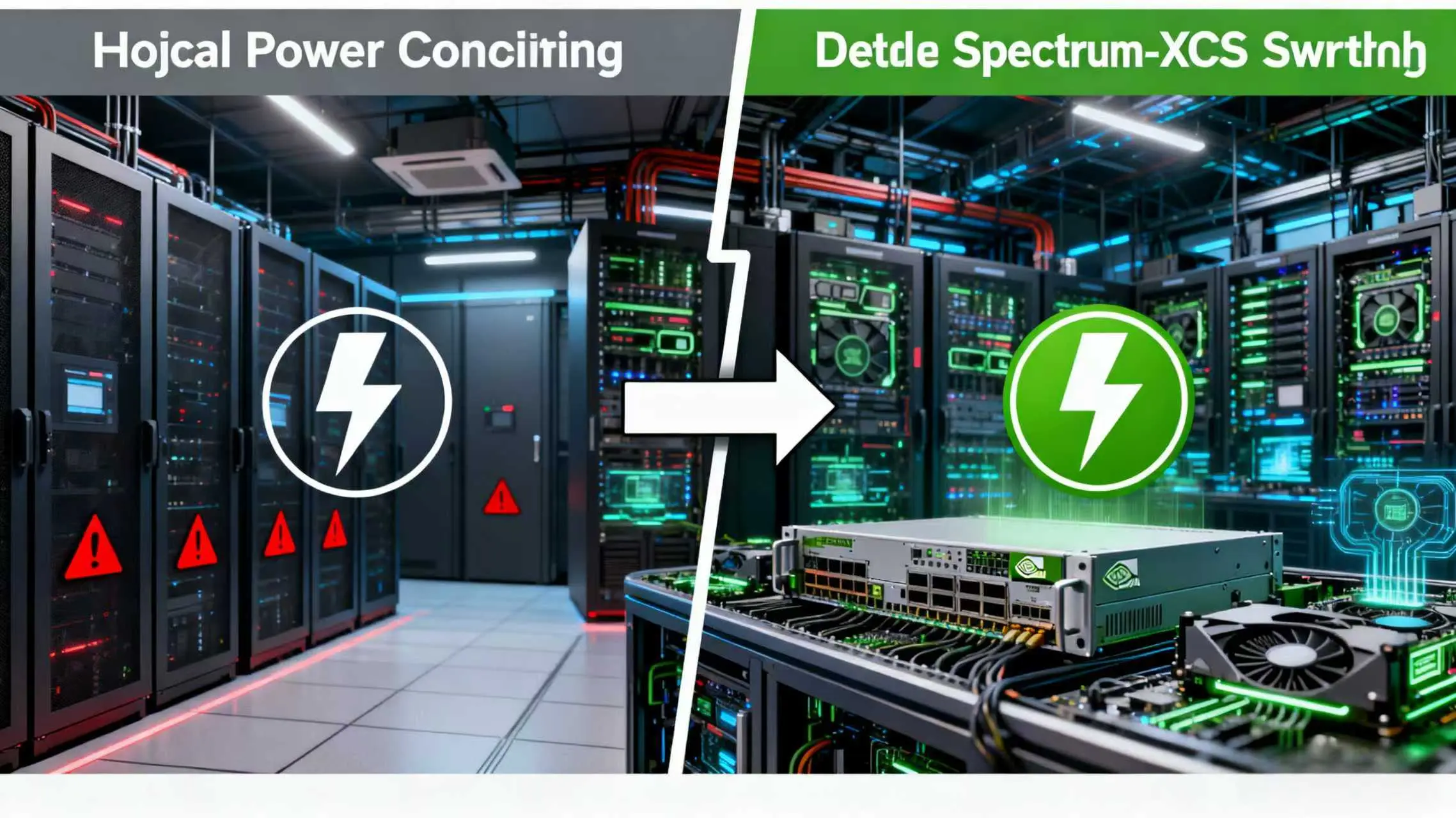
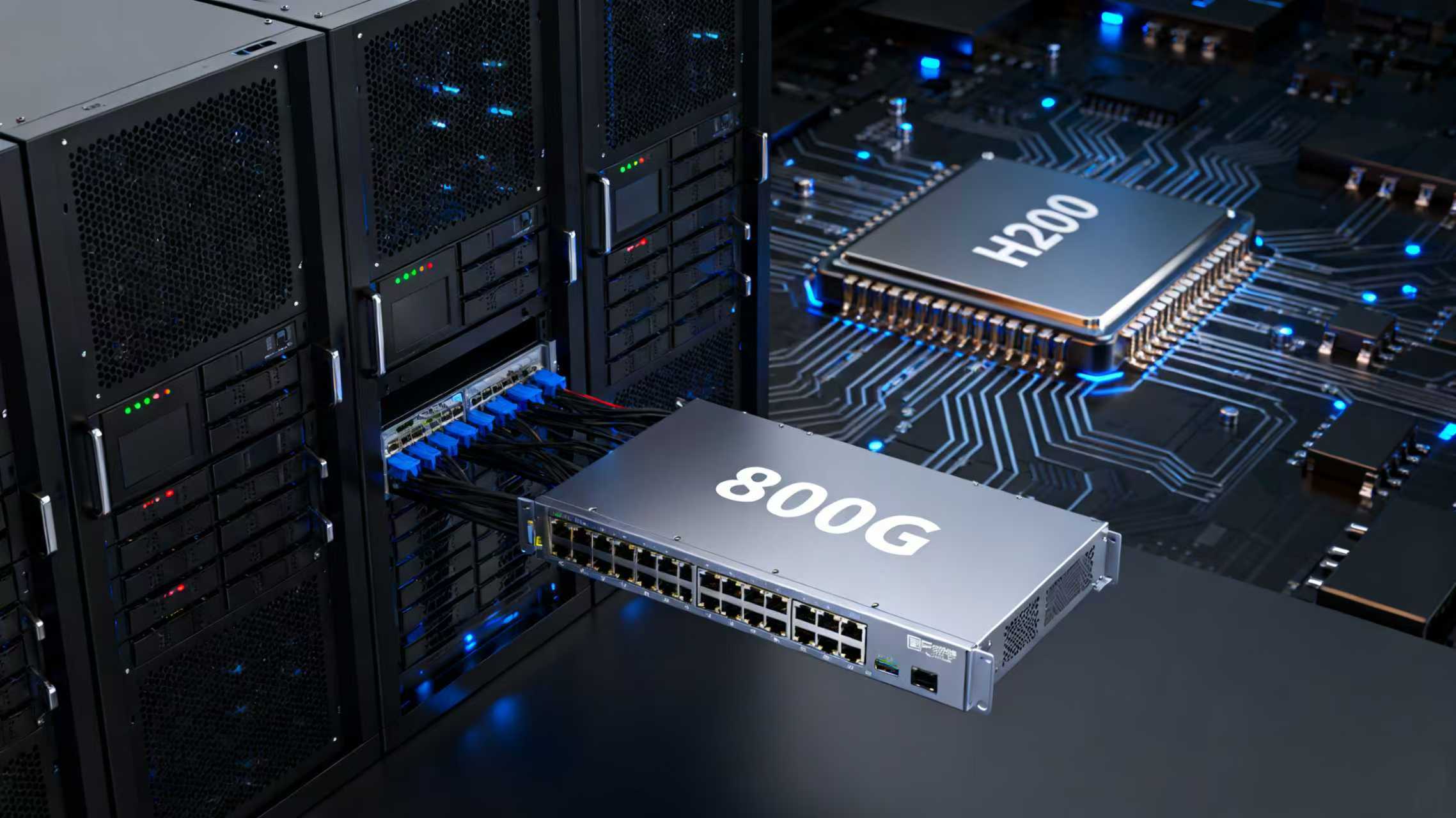
Thirdly, deep collaboration with the existing ecosystem. Spectrum-XGS fully leverages the hardware foundation of the Spectrum-X platform, including switches supporting 800Gb/s ports and ConnectX-8 SuperNICs. A single device can provide 409.6Tb/s of switching capacity, meeting the concurrent communication needs of tens of thousands of GPUs. Simultaneously, its seamless integration with the CUDA-X library and NVIDIA Collective Communications Library (NCCL) allows developers to directly enjoy the performance benefits of cross-domain scaling without modifying code, improving cross-data center AI training efficiency by 1.9 times.
Notably, Spectrum-XGS incorporates Co-Packaged Optics (CPO) technology, packaging the optical engine and switching chip on the same substrate, reducing port power consumption from the traditional 30W to 9W and signal loss by 80%, providing crucial energy efficiency guarantees for long-distance, large-scale transmission, and propelling computing communication from the "electrical era" into the "optical era."
II. Strategic Positioning: The "Third Pillar" of AI Computing, Completing the Three-in-One Architecture
The release of Spectrum-XGS marks NVIDIA's completion of a "three-in-one" computing network strategic layout covering from the chip level to the global level. Previously, AI computing power expansion primarily relied on two paths: Scale-Up (vertical scaling) through NVLink technology to achieve full interconnection of GPUs in a single node, addressing the problem of computing power density in a single device; and Scale-Out (horizontal scaling) using the Spectrum-X Ethernet platform to achieve cluster expansion within the same data center. Spectrum-XGS defines Scale-Across (cross-regional scaling), becoming the "third pillar" supporting AI computing power to break through geographical boundaries.
"These three pillars together constitute the infrastructure backbone of an AI super factory," said NVIDIA CEO Jensen Huang at the press conference. "When the power and space of a single data center reach physical limits, cross-domain computing power integration becomes an inevitable choice. Spectrum-XGS enables independent data centers distributed globally to work together like a logically unified 'gigawatt-scale AI super factory'."
The commercial value of this strategic layout is particularly significant. With the explosion of generative AI and autonomous AI applications, the demand for computing power for training trillion-parameter models is growing exponentially, and single-data center GPU clusters are no longer sufficient. Spectrum-XGS, through cross-domain computing power scheduling, can dynamically integrate data center resources from different regions, such as connecting data centers in Europe with R&D clusters in North America, providing seamless computing power support for multimodal training in drug discovery for multinational pharmaceutical companies. For older data centers with power limitations, it eliminates the need for large-scale hardware upgrades; simply deploying Spectrum-XGS allows them to access the global computing network, extending the equipment's lifespan while meeting high-performance computing needs.
III. Application Implementation: From Cloud Service Providers to Edge Computing, Scalable Deployment in Multiple Scenarios
Currently, Spectrum-XGS has entered the large-scale commercialization stage, initially implemented in scenarios such as hyperscale cloud service providers, enterprise hybrid clouds, and edge-cloud collaboration. American cloud service provider CoreWeave has become one of the first deployment customers, integrating data centers distributed across multiple cities into a unified supercomputer using Spectrum-XGS, providing customers with on-demand access to petawatt-scale AI computing power. When a customer needs to train a trillion-parameter large model, CoreWeave can dynamically schedule cross-regional GPU resources, avoiding computing power bottlenecks in a single data center and shortening the model training cycle by 40%.
In the enterprise market, industries sensitive to data sovereignty, such as finance and healthcare, are leveraging Spectrum-XGS to build cross-regional private cloud interconnection architectures. For example, a multinational bank can securely connect its transaction data centers in the Asia-Pacific region with risk control clusters in the Americas, achieving global computing power sharing while meeting data localization compliance requirements and improving the training efficiency of risk prediction models.
In the field of edge computing, Spectrum-XGS is becoming a key support for vehicle-road-cloud integration. In autonomous driving scenarios, the edge computing power of roadside units (RSUs) can be interconnected with cloud training clusters in real time through this technology. Real-time data generated by global test fleets can be quickly transmitted back to the training cluster, increasing the model iteration speed by 58%. A relevant NVIDIA representative revealed that future large-scale AI projects such as Tesla's Dojo supercomputer plan to adopt Spectrum-XGS to build a global autonomous driving training network.
In terms of green computing, Spectrum-XGS's cross-domain scheduling capabilities provide a new path for clean energy utilization. AI training tasks can be dynamically allocated to regions rich in renewable energy sources, such as utilizing Nordic hydropower data centers during the day and switching to Middle Eastern solar parks at night, achieving 100% clean energy support and helping companies reduce their carbon footprint.
IV. Industry Shakeup: Reshaping the Competitive Landscape and Building a Technological Moat
The launch of Spectrum-XGS is reshaping the global competitive landscape of AI infrastructure. Traditional Ethernet vendors such as Cisco and Arista, while holding a certain market share in the enterprise network market, have a significant technological gap in cross-domain AI communication – their solutions rely on general WAN protocols, which cannot meet the low-latency and high-determinism requirements of AI training. Although Cisco has partnered with Nvidia through its Silicon One chip, it has not yet launched an equivalent cross-domain AI communication technology; Arista's 7400 series switches support the RoCEv2 protocol, but lack key innovations such as dynamic distance adaptation and CPO. AMD, due to insufficient network technology accumulation, has fallen behind Nvidia in this field.

Market research firm Dell’Oro Group predicts that by 2030, the market size of Ethernet-based cross-domain AI networks will exceed $80 billion, and Nvidia, with its first-mover advantage and ecosystem barriers, is expected to capture more than 60% of the market share. Currently, Nvidia's market share in the AI chip market has increased from 82% in 2023 to 89% in 2025, and the launch of Spectrum-XGS will further consolidate its dominant position in the AI infrastructure field.
In terms of ecosystem building, Nvidia, through its "Spectrum-XGS + Jetson Thor + Isaac Sim" bundling strategy, has attracted more than 1,200 robotics developers and cloud service providers to join its ecosystem. Leading cloud vendors such as Microsoft Azure and AWS have announced partnerships with Nvidia, planning to deploy Spectrum-XGS in global data centers to build a new generation of AI computing networks. This "hardware + software + ecosystem" three-pronged approach has created an insurmountable competitive barrier, making it difficult for competitors to catch up technologically in the short term. V. Future Outlook: Quantum Communication Integration and the Evolution of Computing Networks
Looking ahead, NVIDIA plans to continuously iterate on Spectrum-XGS technology. The next-generation product may incorporate quantum communication technology, reducing cross-domain latency to the microsecond level and supporting distributed training of trillion-parameter models. Simultaneously, with the mass production of TSMC's 3nm process, equipment costs are expected to further decrease, promoting the widespread adoption of cross-domain computing applications by small and medium-sized enterprises.
In terms of technology integration, Spectrum-XGS will deeply collaborate with NVIDIA's physical AI technology. Robots equipped with the Jetson Thor module can use Spectrum-XGS to access cross-domain GPU resources for complex inference, and then feed the results back to the local actuator, with the entire process controlled within 50 milliseconds. This "cloud computing + edge execution" closed loop will drive autonomous AI applications from the laboratory to large-scale commercial use.
"Spectrum-XGS is not just a product, but an evolutionary blueprint for AI computing networks," Huang Renxun emphasized at the press conference. "When geographical distance is no longer an obstacle, the physical boundaries of data centers will completely disappear at the logical level, and a globally collaborative, planetary-scale AI hub is forming." With the popularization of this technology, AI training will break free from the limitations of a single data center, and the pace of innovation in cutting-edge fields such as autonomous AI and quantum computing is expected to increase exponentially, injecting strong momentum into the new industrial revolution.
The release of NVIDIA Spectrum-XGS not only solves the technical challenges of cross-domain computing integration but also redefines the development direction of AI infrastructure. Through deep collaboration between algorithms and hardware, this product transforms dispersed data centers into a unified computing network, providing a more efficient, flexible, and sustainable development path for the global AI industry. In this computing revolution, NVIDIA is using technological innovation as its pen and the global network as its paper, writing the future chapter of a planetary-scale AI superfactory.